Most AI app builders skip the thinking and go straight to the code. You type a prompt, you get an app, and a week later you realize you built the wrong thing. The research never happened, the requirements were never written down, and nobody approved anything before the building started.
ProductOS works the other way round. It builds from a real PRD, not a prompt. Agents research the market first, write and edit an approvable PRD section by section, build a design system from your brand guidelines, and only then write code in a cloud sandbox — with your approval at each stage. The code is reviewed, previewed live, and published to a ProductOS subdomain or your own custom domain, with GitHub sync on every tier.
The ProductOS lifetime deal starts at $84.15 (live 15% promo price) once for lifetime platform access. There are five tiers, going up to $1,274.15, and higher tiers add more one-time launch credits, more concurrent AI agents, more live products, and more users. The credits are the catch to understand: launch credits are one-time only and never refill, and hosting consumes credits monthly, so AI usage and hosting cost extra on top of the lifetime price.
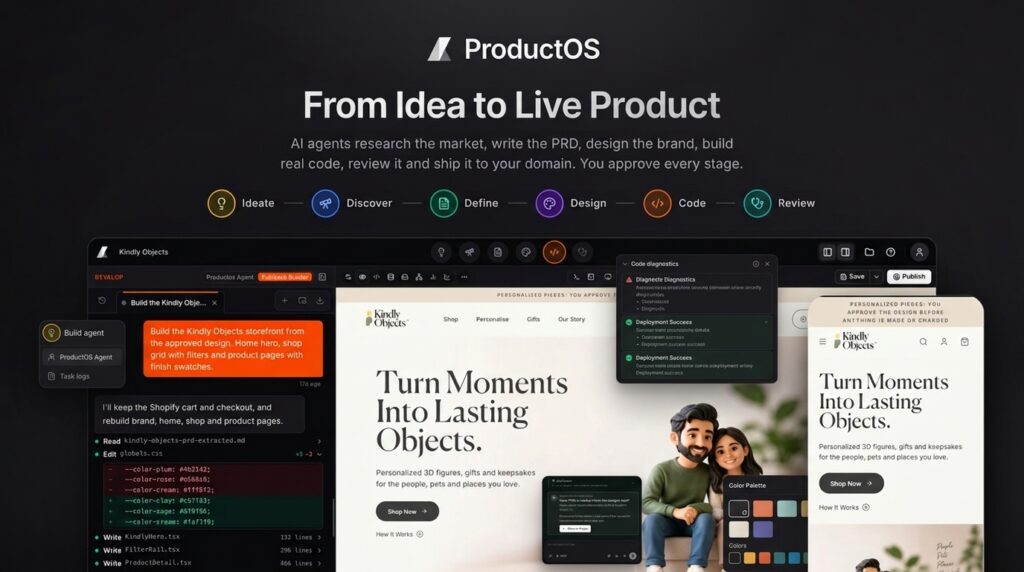
Core Features of ProductOS Lifetime Deal
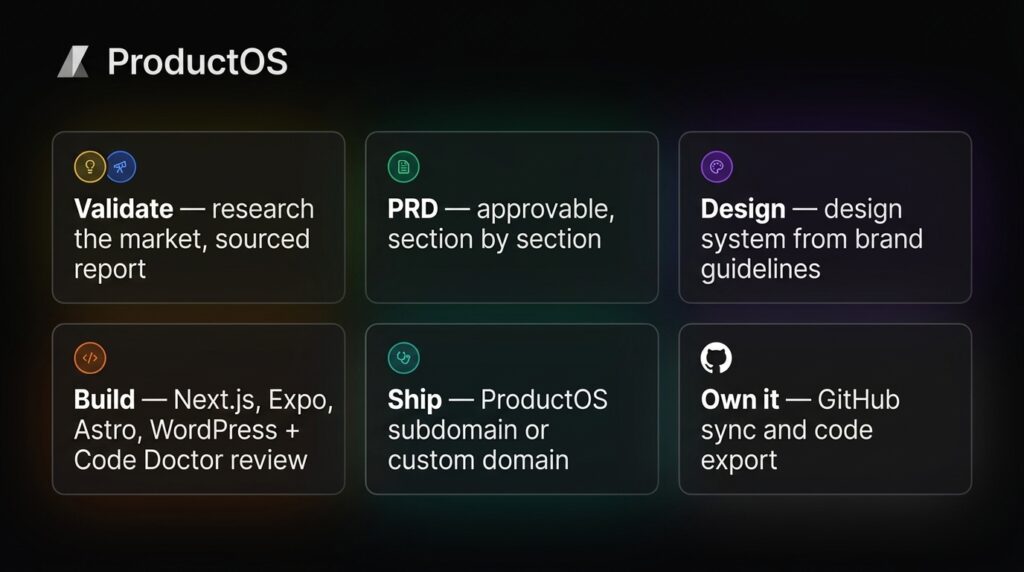
Research Before You Build
The Ideation agent asks key questions and writes a concept, target user, and core flow. Then the Research agent searches the web, reads pages, and saves a sourced report with retrieval dates and source links. I can also upload customer interviews or run surveys alongside the desk research. For me, this is the step prompt-to-app tools skip, and it is the step that stops me building something nobody wants.
A Real PRD, Edited Section by Section
The brief and the research become a PRD covering decisions, audience, brand, information architecture, UX flows, technical architecture, data model, SEO, and acceptance criteria. I can attach an existing spec, edit any section, and save or export it. Design does not start until every section is done, and the research and PRD carry forward into the build. Nothing is built from a vague one-liner.
Design System From Your Brand
ProductOS builds brand guidelines in four steps — name and logo, colour palette, type, and vibe, with role and contrast notes — and I can upload brand files and mood boards. From there it generates a design system, user flows, and UI screens on separate tabs, which I preview and edit before any code is written. The app looks like mine from the start, not like a template wearing my colours.
Build, Review, and Deploy in a Sandbox
The agents write Next.js, Expo, Astro, or WordPress code in a cloud sandbox, with tests, a build step, and desktop and mobile live previews. Code Doctor reviews the result, listing findings worst-first with a root cause and a suggested fix. Then I publish in one click to a ProductOS subdomain and connect a custom domain, with manual or automatic deploys. Founder answers say the builds can include databases, auth, APIs, and Stripe Checkout and webhooks, with external services such as Supabase and Stripe where needed — I am treating those as founder claims, not page-verified features.
Ownership, GitHub Sync, and MCP
Every tier includes GitHub sync and code export, with a separate GitHub repo per project, so the code is mine to keep. MCP support connects Claude Code, Cursor, Codex, and other MCP-compatible clients, so I can drive the platform from the AI assistant I already use. Private drafts are unlimited on every tier, which means I can explore ideas without burning a live-product slot.
Pros of ProductOS
- Research-first workflow: market research and a sourced report come before any code.
- An approvable PRD: decisions, audience, flows, architecture, and acceptance criteria, edited section by section.
- Approval at each stage: design only starts when the PRD is done, and code only follows the approved design.
- Design system included: brand guidelines, flows, and UI screens built from your own brand files.
- Code you own: GitHub sync and code export on every tier, with a separate repo per project.
- Code Doctor review: findings listed worst-first, with root causes and suggested fixes.
- Ships to web, iOS, and Android: Next.js, Expo, Astro, or WordPress from one context.
- Unlimited private drafts: explore as many ideas as you like without using a live slot.
Cons of ProductOS
- Credits never refill: launch credits are one-time only, with no recurring included credits, so ongoing AI work and hosting need separately purchased top-ups.
- Hosting is not free for life: hosting consumes credits monthly, even though platform access is lifetime.
- Only 1 live product on Tiers 1–3: exporting to GitHub does not free a slot — the product must be archived or deactivated.
- No stacking and no capacity add-on: the only route to more agents or products is upgrading or downgrading between tiers.
- Early-stage Radar risk: AppSumo has not fully vetted the claims or reviewed the code, success is not guaranteed, and AI skills are non-refundable once redeemed.
- BYOK is not available yet: custom AI provider support was on the roadmap, targeted within 1–2 weeks from October 26, 2026 — a future claim, not a shipped feature.
- No strict zero-data-retention claim: code and data are not used to train models, but some data must be retained to run the platform.
- Software only: it does not directly support physical product development, though early research and planning stages can be used for physical ideas.
- One review so far: a single 5-star AppSumo review, so buyer feedback is almost nonexistent.
Who is ProductOS best for?
- Product managers: people who already think in PRDs and want an AI builder that respects that process.
- Solopreneurs: solo founders validating an idea before paying for development.
- Founders without a dev team: non-coders who want to ship a real product, not just a prototype screenshot.
- First-time builders: anyone who has been burned by a prompt-to-app tool building the wrong thing.
- Small teams shipping MVPs: teams that need research, design, and code in one context with checkpoints they can approve.
ProductOS AppSumo Pricing Plan
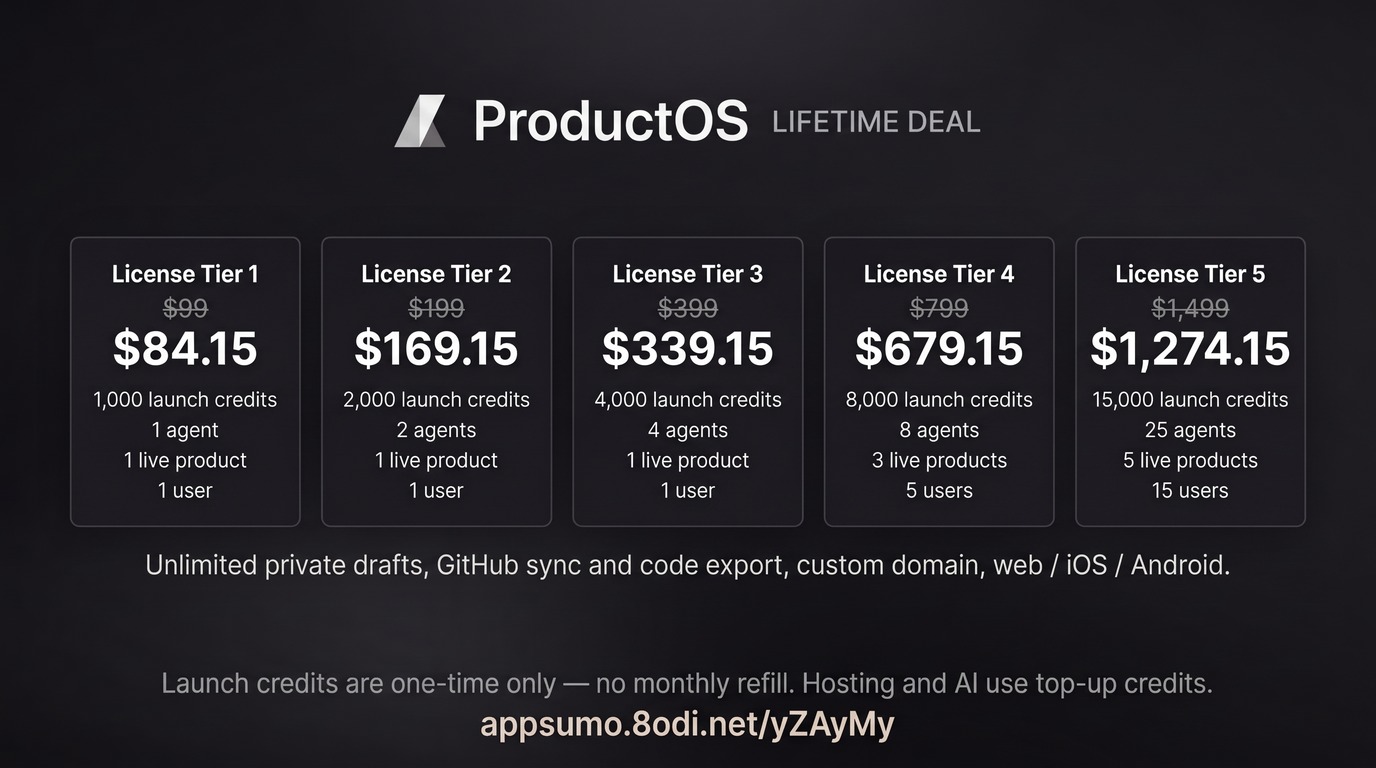
Every tier includes the same shared base: unlimited private drafts, lifetime platform access, GitHub sync and code export, custom domain publishing, and web, iOS, and Android apps. What grows between tiers is launch credits, concurrent agents, live products, and users. Remember: launch credits are one-time only and never refill, and hosting consumes credits monthly — top-up credits are purchased separately. Prices below are the live 15% promo prices — each tier shows its regular price struck through on the AppSumo page. I am not presenting calculated percentages beyond the 15% shown.
License Tier 1 — $84.15
- One-time payment of $84.15 (list price $219; regular $99 struck through, 15% off as shown)
- Lifetime access to ProductOS
- 1,000 one-time launch credits
- 1 concurrent AI agent
- 1 live product
- 1 user
- Unlimited private drafts
- GitHub sync and code export
- Custom domain publishing
- Web, iOS, and Android apps
- Research, PRD, design system, and staged build workflow with approval gates
- Code Doctor review and live preview
- All future plan updates
- Activate within 60 days of purchase
- 60-day money-back guarantee; AI skills non-refundable once redeemed
License Tier 2 — $169.15
Includes everything in License Tier 1, plus:
- One-time payment of $169.15 (list price $449; regular $199 struck through, 15% off)
- 2,000 one-time launch credits
- 2 concurrent AI agents
License Tier 3 — $339.15
Includes everything in License Tier 2, plus:
- One-time payment of $339.15 (list price $899; regular $399 struck through, 15% off)
- 4,000 one-time launch credits
- 4 concurrent AI agents
License Tier 4 — $679.15
Includes everything in License Tier 3, plus:
- One-time payment of $679.15 (list price $1,799; regular $799 struck through, 15% off)
- 8,000 one-time launch credits
- 8 concurrent AI agents
- 3 live products
- 5 users
License Tier 5 — $1,274.15
Includes everything in License Tier 4, plus:
- One-time payment of $1,274.15 (list price $3,299; regular $1,499 struck through, 15% off)
- 15,000 one-time launch credits
- 25 concurrent AI agents
- 5 live products
- 15 users
There are no codes and no stacking — you choose the plan, and you can upgrade or downgrade between the five tiers later. A refund revokes the license and any unused credits granted with it, but not independently purchased top-up credits. Check the live listing for the ProductOS lifetime deal before buying, since AppSumo deals can change.
How to Get an Extra 10% OFF On ProductOS Lifetime Deal?

- Follow the instructions and get the extra benefit of 10% OFF 😉
- Go to this link AppSumo and get 10% OFF
- You will see a pop-up form comes for unlocking a 10% discount
- Provide your email there and claim your discount
- Note: This is available for first-time purchases only
5 Best ProductOS Alternatives 2026
If ProductOS is not the right fit, here are the closest alternatives I know.
ProductOS vs Lovable
Lovable is a prompt-to-app builder with one credit balance for building, hosting, and in-app AI, known for fast prototypes and clean output.
- Starting price: Free plan; Pro from $25/month (100 credits/month)
- Main advantages: fast prototypes, custom domains, code editing and download on paid plans, credits roll over while subscribed
- Main limitation: no PRD or research-first workflow — prompts go straight to building, and credits also pay for hosting and running the live app
- Difference from ProductOS: Lovable builds from a prompt; ProductOS researches and writes an approvable PRD before any code
ProductOS vs Bolt.new
Bolt.new is a browser-based AI app builder metered by tokens, for fast full-stack builds with hosting included.
- Starting price: Free plan (1M tokens/month); Pro $25/month (10M tokens/month)
- Main advantages: fast full-stack builds in the browser, hosting included, custom domains on Pro
- Main limitation: token use scales with project size, since every prompt re-syncs project files, so large projects burn the allowance fast; no PRD or research stage
- Difference from ProductOS: Bolt.new builds fast from prompts; ProductOS validates the idea and the PRD first, with approval gates
ProductOS vs Emergent
Emergent is a multi-agent AI app builder for web and mobile, with GitHub export on paid plans.
- Starting price: Free plan (10 credits/month); Standard $20/month (100 credits/month); Pro $200/month (750 credits)
- Main advantages: full-stack builds with mobile support, GitHub export on paid plans
- Main limitation: credit-based, with debugging burn a common complaint, hosting consumes credits per deployed app, and the jump from Standard to Pro is steep
- Difference from ProductOS: Emergent’s agents build directly; ProductOS stages research, PRD, design, and build with checkpoints
ProductOS vs v0
v0, from Vercel, is an AI UI and app builder that turns prompts into interfaces quickly, with Vercel hosting and deployment.
- Starting price: Free plan; Plus $30/user/month; Business $100/user/month
- Main advantages: polished UI generation, Vercel hosting and deployment, GitHub sync
- Main limitation: UI-first — no market research or PRD workflow, no native mobile builds, and hosting is billed separately on Vercel
- Difference from ProductOS: v0 generates interfaces fast; ProductOS starts from research and a PRD and ships web plus native mobile from one context
ProductOS vs Cursor
Cursor is an AI-native code editor, a VS Code fork with Tab completion and an agent for multi-file work, built for developers.
- Starting price: Free Hobby tier; Pro $20/month (Pro+ $60, Ultra $200)
- Main advantages: best-in-class inline editing and agent coding inside a real editor, multi-model support, cloud agents
- Main limitation: it is an editor for people who code — no research, PRD, or design stages, no hosting or publishing pipeline, no no-code path
- Difference from ProductOS: Cursor helps developers write code faster; ProductOS takes a non-coder from idea to PRD to design to a shipped app
Which ProductOS alternative fits best?
Pick Lovable if you want the fastest prompt-to-prototype loop and accept monthly credits. Pick Bolt.new if you want fast browser-based full-stack builds and can manage token burn. Pick Emergent if multi-agent web and mobile builds matter most. Pick v0 if polished UI and Vercel deployment are the priority. Pick Cursor if you code and want the best AI editor. Pick ProductOS if you want research, an approvable PRD, and approval gates before a line of code is written — and you accept that credits, not the lifetime price alone, pay for AI work and hosting.
Final Thoughts – ProductOS Review 2026
What I like most about ProductOS is the discipline. Research, then PRD, then design, then code, with an approval gate at each stage, is how good products are actually built — and it is the opposite of typing a hopeful prompt and fixing whatever comes back. The Code Doctor review and the GitHub ownership on every tier make it feel like a real development workflow, not a demo generator.
The honest cautions are the credits and the early stage. Launch credits never refill, hosting eats credits monthly, and Tier 1 allows only one live product, so the lifetime price is the entry ticket, not the total cost. It is also a Radar listing with a single AppSumo review, and BYOK is still a roadmap promise. The sole reviewer flags exactly the same credit point, which tells me it is the thing to price in before buying.
At $84.15 once (15% off), the ProductOS lifetime deal is worth it for a product manager, solopreneur, or founder who values the PRD-first process and will actually use the checkpoints. Go in knowing the credits are metered, start on Tier 1, and let the 60-day refund window cover the experiment.